Adaptation planning must include 1.5°C overshoot scenarios


Adaptation planning should include the impacts that can be avoided by high mitigation ambition – including which impacts are reversible from overshooting the 1.5°C limit and which are irreversible. This includes mitigation actions themselves, such as carbon dioxide removal, to avoid land use challenges.
Share
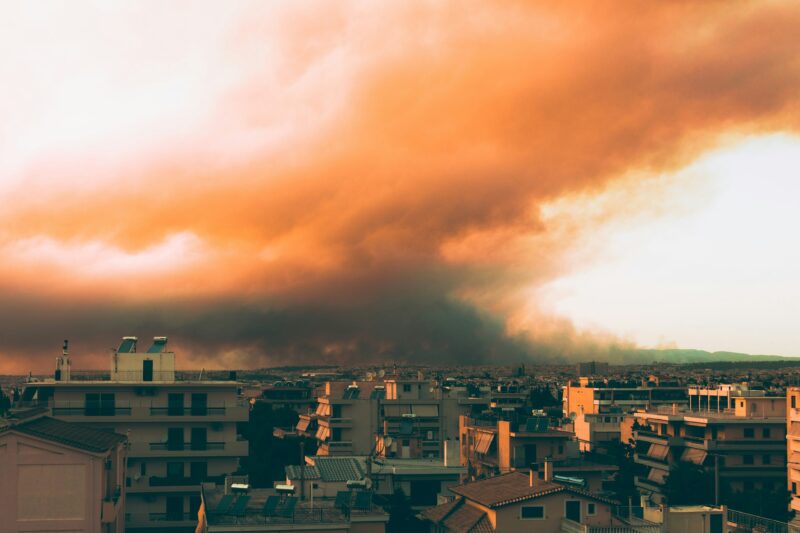
The world is getting alarmingly close to global warming of 1.5°C and overshooting this limit is becoming inevitable. Ample scientific evidence shows the warmer it gets, the worse impacts and damages will be. There are limits to adaptation, so it is clear we will not be able to “adapt our way out” of this looming crisis.
Continued and rapidly strengthened mitigation that limits the magnitude and duration of a 1.5°C overshoot is critical to slow warming down within two decades and then bend the curve downward. Even with sufficient mitigation action to limit 1.5°C overshoot, there is a very high need for adaptation measures, given emerging and expected impacts even at 1.5°C.
Even at current levels of warming, Europe has been battered in recent years by extreme heat, wildfires, flooding, and droughts taking lives and livelihoods.In the face of these worsening events, and to prepare for end-of-century warming, a new report from the European Scientific Advisory Board on Climate Change (ESABCC) advising the European Union EU, calls on the EU to urgently strengthen its policy framework for effective and coherent adaptation, including adopting a common reference scenario for adaptation planning across Member States.
In itself, that is a valid call.
But the ESABCC report recommends the EU consider only one temperature scenario: 2.8–3.3°C of global warming by 2100, covering the range of temperature projections from current policies. While it does recommend considering hotter possible futures, there was no mention of the necessity or value of considering how adaptation should look in scenarios of overshoot where temperatures rise above 1.5°C and then fall back to safe levels. Nor is there an account of how residual damages would be much more manageable at 1.5°C.
This sends a misguided message that 2.8–3.3°C of warming is baked in. The focus on a high level of warming created a false impression – that media immediately amplified – both that this scenario inevitable, and that Europe could adapt to this level of warning.
But reaching 3.3°C or even 2.8°C by 2100 is not set in stone. We can and must reach zero global CO2 emissions by mid-century and net negative emissions thereafter (and equally rapid action on non-CO2 emissions like methane). We have almost 75 years to bend the curve and get back on a path to safe levels of warming well below 1.5°C by the end of the century. Our Highest Possible Ambition scenario shows how.
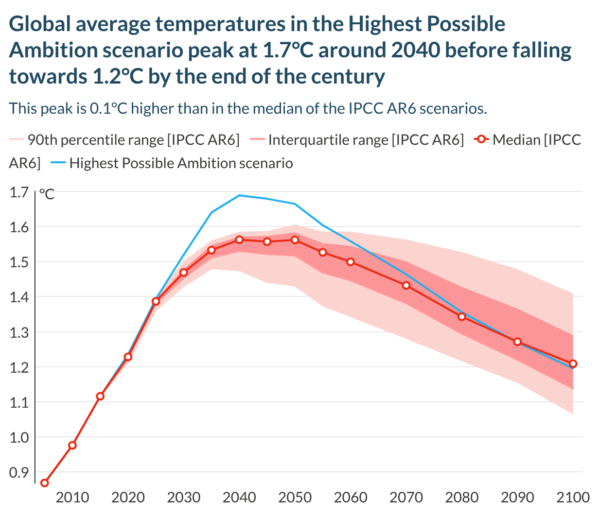
Why we need to include overshoot in adaptation planning
Robust adaptation planning should consider several scenarios – including high and low warming scenarios and the socioeconomic impacts at different warming levels, such as the impacts on health and the economy.
Our recent report detailing extreme heat risks in Germany found under current policies, the annual number of heat wave days for eight German cities is projected to more than double by 2100, compared to 2020 levels, amounting to over 50 heat wave days per year in Frankfurt am Main. and over 40 in Hamburg. Under a 1.5°C Paris-Agreement-compatible scenario, these severe increases could be avoided. At lower levels of warming, cities are better equipped to respond to acute heat events, especially when it comes to heat-related mortality and labour productivity losses.
Overshoot scenarios need to be included in adaptation planning, because they fundamentally alter overall priority setting, costs and benefits, and implementation timing of adaptation options. (See the Climate Risk Dashboard for details on how.) This also allows planners to optimise for synergies between mitigation and adaptation.
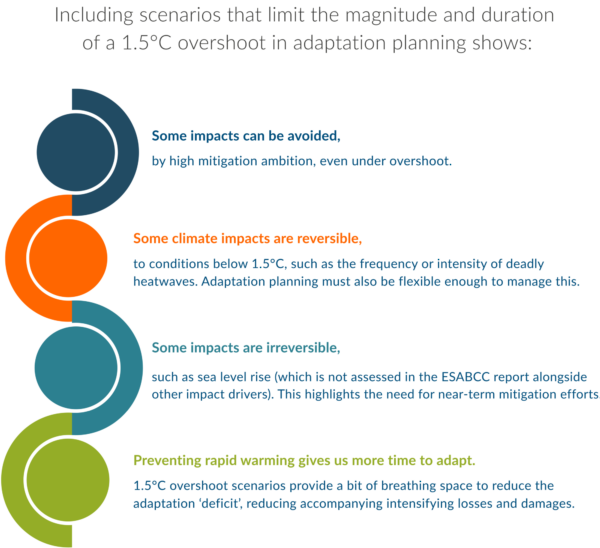
Early studies on overshoot and adaptation showed that adaptation practitioners had not yet considered overshoot in their adaptation planning, necessitating the co-development of adaptation scenarios that account for overshoot and overshoot proofing adaptation plans. The initial thesis from these early studies that peak warming, not long-term warming outcomes, determine adaptation needs has since evolved. In the recently held Overshoot Conference, experts proposed that “the level, timing and duration of overshoot will be a determinant of adaptation limits and will influence the status and functioning of ecological and social systems, along with the effectiveness and costs of adaptation options.”
Adaptation best practice
The exclusion of lower warming scenarios sends the wrong signal of siloing mitigation and adaptation. Adaptation and mitigation must go hand in hand, with ambitious climate action complemented by the implementation of a portfolio of effective adaptation measures. Countries are increasingly asking for guidance on the synergies across adaptation, mitigation, and the Sustainable Development Goals.
A society can be locked into certain adaptation pathways because of their feasibility, scale, cost, or transformational capacity, and the magnitude of climate risks to be addressed. This means implementing adaptation actions in isolation from mitigation measures could lead to unseen costs, trade-offs, and so-called disbenefits.
Including lower warming scenarios alongside the widest possible range of adaptation conditions is crucial for local land use planning and reduces the potential for maladaptation. Lower warming scenarios driven by high mitigation ambition need widescale carbon dioxide removal (CDR) deployment. This must be planned alongside deployment of physical adaptation measures to avoid land use challenges.
Flexible sequencing of adaptation measures that addresses several warming trajectories and socioeconomic conditions can avoid lock-in and stranded assets. Some climate impacts, like sea level rise, show the long-term implications of historical and pledged GHG emissions and how crucial strong near-term mitigation efforts in line with 1.5°C are for limiting sea level rise risks in vulnerable coastal regions, including Europe’s northern coast and Small Island outer territories.
What the EU does sets precedent and leadership for the rest of the world. Adaptation planning in the EU needs to consider both reversible and irreversible impacts, along with the peak and duration of overshoot to avoid lock-in and potential maladaptation.
As Europe prepares for unavoidable temperature increases, we must also not forget vulnerable countries and populations, for whom any rise beyond 1.5°C is not just a climate threshold, but a direct constraint on their livelihoods and a matter of survival for many.