Extreme heat risks in Germany: priorities for adaptation and preparedness
Authors
Share
This report is a key input to a Summary Report by the World Bank highlighting the urgent need for Germany to better prepare for climate related risks.
Heat stress is a growing concern across Europe, and Germany is no exception. Germany is already experiencing intensifying heat waves, with temperatures in early July 2025 reaching up to 40°C in several locations across the country. Due to the ‘heat island effect’ as well as a higher population density, urban areas are particularly affected. In addition, the increasing frequency of compound climate extremes creates multiple dimensions of risk. While some recent advances in policy can be recognised through the development of local heat action and adaptation plans, further action is needed to prepare for rising heat risks.
The aim of this report is, first, to inform about the current and projected changes to heat stress hazard and exposure as a result of climate change, particularly in urban areas; second, highlight the socioeconomic impacts of heat, including on human health, labor productivity, and mortality; third, provide an overview of available heat adaptation options and the policy landscape of heat-health action plans (HHAPs) in Germany, including identified barriers for heat adaptation; and finally, discuss the benefits and costs of selected measures with a focus on preparedness for heat extremes.
Exposure to heat stress is projected to rise substantially across Germany, especially in urban areas
Focusing on seven urban areas in Germany—Berlin, Frankfurt am Main (Frankfurt a. M.), Cologne, Düsseldorf, Munich, Leipzig, Hamburg—we find that heat extremes are projected to rise significantly this century, with levels strongly determined by global climate change mitigation efforts. In a 2020 Climate Policies Scenario, the annual number of heat wave days for all cities is projected to more than double by the end of the century, compared to 2020 levels, amounting to over 50 heat wave days per year in Frankfurt a. M. and over 40 in Hamburg. Under a 1.5°C Paris-Agreement-compatible scenario, these severe increases could be avoided, emphasising the important role of ambitious mitigation action. Regardless, even with ambitious climate mitigation action, German cities will still need to brace themselves for a 25 percent increase in number of heat wave days by mid-century, compared to 2020.
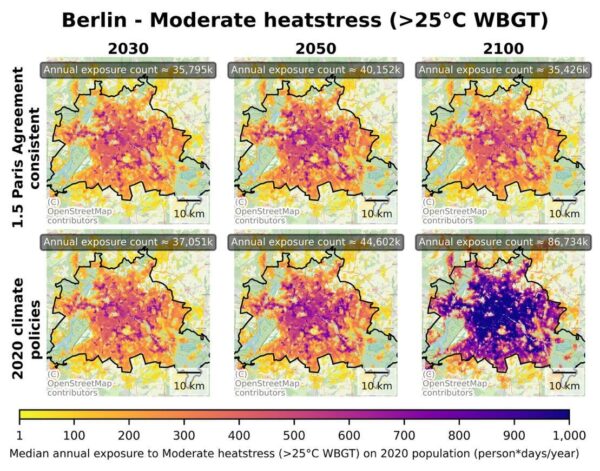
Exposure to moderate heat stress thresholds (>25°C Wet Bulb Globe Temperature [WBGT]) in the seven cities considered in this report is already substantial and would grow sharply with higher levels of global warming, affecting large parts of these city areas. Even moderate heat stress levels can cause health issues for people performing intense activities, for example, outdoor workers.
Maps and aggregated exposure counts (expressed in person days per year) show that these are expected to rise dramatically under a 2020 Climate Policies Scenario. By 2100, exposure counts to extreme heat stress (>31°C WBGT) increase more than tenfold in cities like Berlin, Munich, and Frankfurt a. M. compared to today. Spatial patterns reveal that while hot spots are most pronounced in dense urban cores, large areas outside city boundaries are also affected, highlighting that the burden of heat stress will be widespread. In the 1.5°C Paris-Agreement-compatible scenario, the exposure to heat stress is much less pronounced, especially in the longer term, emphasising the importance of ambitious climate action for reducing exposure to heat risks.
This report forms part of technical assistance under the Technical Assistance Financing Facility (TAFF), financed by the European Commission—Directorate-General for European Civil Protection and Humanitarian Aid Operations—and implemented by the World Bank and the Global Facility for Disaster Reduction and Recovery (GFDRR).