As heatwave sweeps Europe, study warns of growing toll on household incomes
A new Climate Analytics study shows that combined heat-and-drought events already reduce average household incomes by almost 3% across Europe, with much larger losses in the hardest-hit regions.
Share

As a powerful heatwave grips Europe this week, new research underscores the economic costs incurred when extreme heat strikes regions already affected by drought, and shows how climate change is increasing those costs.
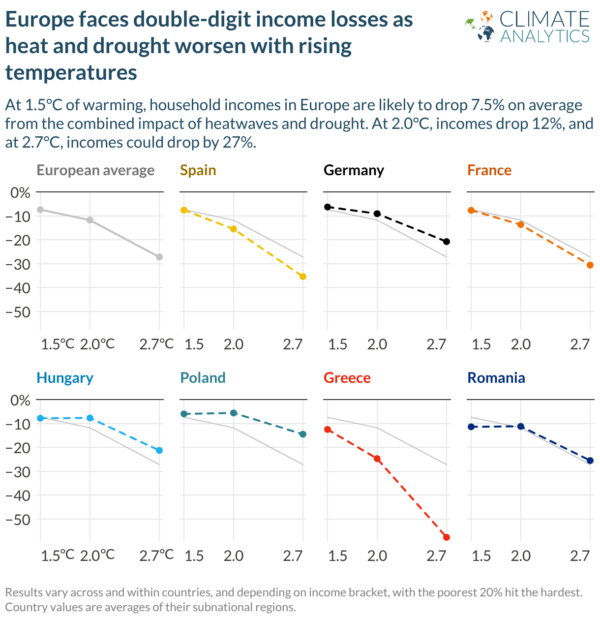
The Climate Analytics study shows that combined heat-and-drought events already reduce average household incomes by almost 3% across Europe, with much larger losses in the hardest-hit regions. It reveals that rising global temperatures will widen income inequality and put millions more Europeans at risk of poverty. If global warming reaches 2.7°C by 2100, as is likely under current policies and action worldwide, the average European household will see its income fall by 27%. Limiting global warming to 1.5°C, the Paris Agreement commitment, would slash this to 7%.
Jessie Schleypen, Senior Climate Change and Development Economist at Climate Analytics and lead author of this study, said, “The massive heatwave now sweeping across Europe is already threatening people’s health, livelihoods and ability to work.
Where extreme heat coincides with drought, the damage can be much greater. Our research shows that these compound events amplify economic losses experienced directly by European households, and they will become more frequent as global warming increases.”
The research analysed data from 2004–2022, and shows that the combined impact of heatwaves and drought is much greater than the sum of the individual events: on average a heatwave in Europe will reduce household incomes by 0.7% and droughts by 1.8%. When they occur together – particularly in drought-stricken regions – the average income loss rises to nearly 3%. Some of the factors driving the decline in incomes include worsening health conditions and reduction in labor productivity, decline in food production and water-related critical services such as transport and energy generation.
Climate change will widen Europe’s income gap further
Published in Global Environmental Change as part of the ACCREU project, the study also shows these effects are not felt evenly.
“The poorest 20% will be affected the most, with incomes dropping 2% more than the rest of the population (4% vs 1.1-1.8%), further widening income inequality,” Schleypen says.
Regions that experienced far more heat waves and droughts between 2004 and 2022 were estimated to have much greater reductions in household income, with Madrid peaking at an almost 10% drop, Central Hungary seeing a 9.4% drop and Central Spain an 8.8% drop.
The increased impact of heatwaves and drought under climate change could mean 60 million people in Europe at risk of poverty in a 1.5°C world, rising to 127 million in a 2.7°C world.
These impacts would also be distributed unevenly, with Greece, Spain, Romania, Bulgaria and Cyprus likely to be among the most affected countries: at 2.7°C of global warming, Spanish household incomes would fall by more than one-third, and Greek household incomes by more than one-half.
“As heat and drought conditions worsen with climate change, so too will the economic impact on Europe’s most vulnerable,” Schleypen says.
Unprepared for impacts
Despite decades of science showing the impacts of continued burning of fossil fuels, Europe remains largely unprepared for the climate impacts its emissions have helped create.
The UK government’s statutory adviser, the Climate Change Committee, said last month that the government’s adaptation plans dating back to 2008 ‘have not been fit for purpose,’ while the French government’s adviser the Haut Conseil pour le Climat said last year that the gap between adaptation needs and adaptation actions is widening.
And in Germany, a Climate Analytics study for the World Bank, published in January 2026, concluded that Germany ‘lacks comprehensive solutions’ to protect people from the increasing heat stress impacts. Despite some slow regional progress in developing heat-health adaptation plans, implementation is still largely lagging.
Press Releases




Rapid methane cuts can still help rescue 1.5°C – governments must build on growing momentum
Action on cutting emissions has been lagging behind for years. Despite commitments to the Global Methane Pledge, the Global Methane Status Report shows that action on methane has been sluggish against earlier forecasts.

Little change in warming outlook now for four years; new 2035 climate targets make no difference
Ten years after the Paris Agreement, the world stands at a critical juncture in the fight against climate change, with little to no measurable progress in warming projections - for the fourth consecutive year, said the Climate Action Tracker in its global update, released at the climate talks in Belém, Brazil, today.