Combating heat stress through urban planning: Integrated case studies for Lisbon and Islamabad
Authors
Niels Souverijns, Dirk Lauwaet, Tiago Capela Lourenço, Inês Gomes Marques, Fahad Saeed, Mariam Saleh Khan, Khadija Irfan, Sarantis Georgiou, Raluca Davidel, Miechel De Paep, Séverine Hermand, Chahan M. Kropf, Kam Lam Yeung, Quentin Lejeune, Inga Menke, Carl Schleussner
Note this study is an output from our project on understanding the climate impacts associated with temporarily overshooting 1.5°C – PROVIDE:
Key messages:
- Lisbon and Islamabad are affected by heat stress in both present and future climate.
- The impact of nature-based solutions on temperature and heat stress is investigated.
- Local stakeholders were involved in the design of the urban nature-based solutions.
- Benefits for reducing heat stress impacts differ depending on the design.
- Strong limits to adaptation are present under a Current Policies scenario.
Nature-based solutions are often proposed as adaptation techniques to heat stress and high temperatures in cities all over the world, but quantifications of their potential effectiveness are lacking.
In Lisbon and Islamabad we co-designed, together with local stakeholders, a selection of urban planning strategies using commonly proposed green and blue infrastructure solutions from literature.
Their effectiveness in reducing temperature and heat stress on climatological time scales were simulated using the UrbClim model, allowing spatial resolutions up to the meter-scale, while potential benefits for sleep loss, heat stress and heatwave exposure were quantified using CLIMADA.
The study found green and blue infrastructure generally offer local relief with respect to heat stress, reducing heat stress days by up to 40%, mainly by providing shading from direct sunlight and by reducing land surface temperatures. Nighttime temperatures are most efficiently reduced by unsealing urban areas, while daytime temperatures benefit most from increases in high vegetation and trees (both up to 0.5°C).
To maximize benefits for the population, urban planning strategies should focus on areas with highest population densities, as temperature reductions and heat stress relief quickly decay outside of the areas of intervention.
Despite their proven positive effects, the investigated green and blue urban planning strategies clearly reveal limits to adaptation towards the future, especially in a Current Policies scenario, as they only offset part of the projected heat stress impacts.
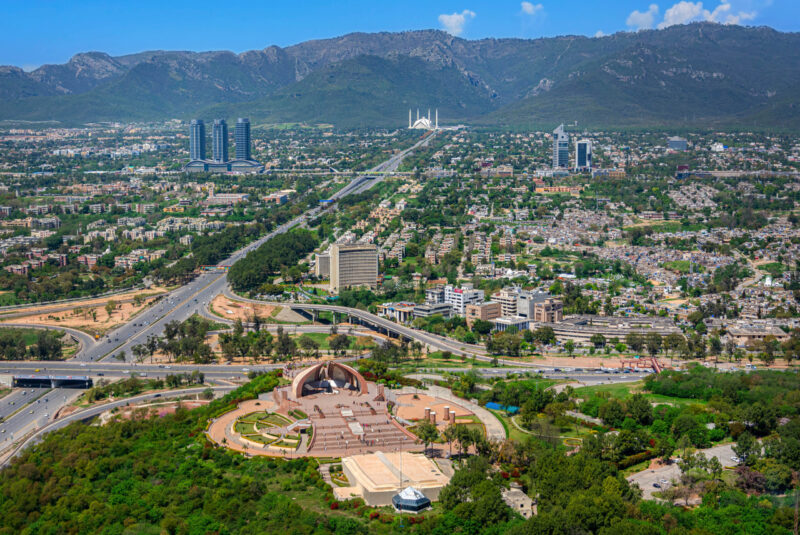
Image: The E-11 sector of Islamabad. © M.H. Toori (used with permission)