Caribbean Journalists Converge to Strengthen Climate Reporting
Bianca Beddoe
Following the hottest decade in recorded history and regional drought challenges, the CA Caribbean media training workshop, “Reporting Climate Impacts in a Climate Justice Context”, delivered learnings from policy leaders, climate experts, and media stalwarts from across the Caribbean to enhance reporting on an issue of critical significance to vulnerable island states.
Share
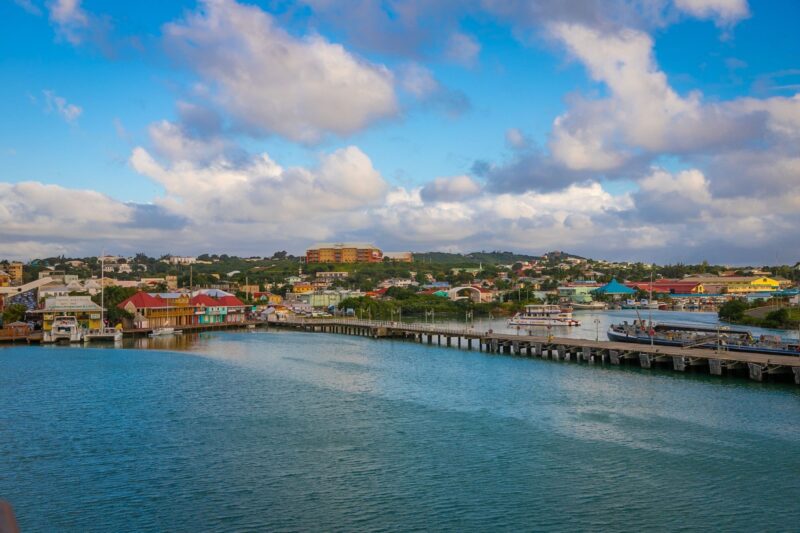
Scores of media practitioners across the Caribbean Community joined the “Reporting Climate Impacts in a Climate Justice Context” on Wednesday 18th March, a professional development workshop hosted by the Media Institute of the Caribbean and Climate Analytics Caribbean in Port of Spain, Trinidad. Journalists, editors, content creators, and students were engaged in sessions to fortify climate reporting capacity with an emphasis on accuracy, context, and justice frameworks. Participants joined in person and online and learned how worsening climate impacts are weakening regional resilience and threatening islands’ national development.
Dr. James Fletcher, CARICOM Climate Envoy, made the sobering statement that his home country of St. Lucia is now having to import water from Dominica. Despite its negligible contribution to greenhouse gas emissions, St. Lucia is presently being challenged by impacts of the climate crisis in the form of a severe drought.
“In my own country of St. Lucia, we are experiencing severe drought, and this is just the beginning of the dry season,” Dr. Fletcher stated. “We have the phenomenon of farmers abandoning their crops, schools having to be closed because there is no water. People are being subjected to heatstrokes. Climate impacts are taking a real emotional toll. Across our islands we are seeing stronger and more destructive hurricanes. Category 5 hurricanes were a rarity, now it is becoming a norm. There is just so much energy stored in the oceans, which is where the hurricanes get their power, that intensification happens so very quickly. Rising sea levels spell disaster for us as we all live and work near the coastlines.
Journalists play an extraordinarily important role in shaping how societies understand major global challenges. And there is perhaps no issue today where that role is more important than in the case of climate change.”
Dr. Fletcher was a leader of the Caribbean’s historic “1.5 To Stay Alive” international campaign and was integral to the achievement of the Paris Agreement within the United Nations Framework Convention on Climate Change.
He noted that Caribbean contributes less than 0.25% of global emissions, yet it is among the regions which are most vulnerable to the escalating impacts of climate change. Global data conclusively shows that our world has reached a dangerous milestone, with the period 2015 – 2024 becoming the hottest decade in recorded history. 2024 was confirmed as the hottest year on record, and the first year to be more than 1.5°C above the preindustrial era.
Journalists were given insight into global analysis showing how the cost of responding to loss and damage which results from climate change impacts are restricting many islands in a debt cycle. In 2004, Hurricane Ivan cost Grenada 203% of its GDP in damages. In 2017, Hurricane Irma cost the British Virgin Islands 309% of its GDP.
Climate Analytics Caribbean experts shared on pressing climate issues of particular significance to the Caribbean, including the Just Transition, Loss and Damage, Adaptation, and the need to accelerate great ambition on Nationally Determined Contributions (NDCs) to limit 1.5°C overshoot.
Carlon Mendoza, Climate Analytics Caribbean Climate Policy Advisor – Climate Justice, noted that as the world moves to advance more resilient, greener economies, the Caribbean must ensure that the region is not left behind.
“For the Caribbean, a transition would have to focus on the resilience of our peoples and economies, and the sustainability of their livelihoods,” he stated. “This is also linked to climate finance, debt and disaster recovery, making our transition a justice issue. We cannot be expected to pay for this transition when we are not the ones who have caused this climate crisis.”
Esteemed journalists Ryan Bachoo and Wesley Gibbings, Vice President of the Media Institute of the Caribbean, demonstrated how the media can identify and develop climate angles and highlighted how climate change intersects with virtually every news category from politics and economics to health, culture, and crime.
“Journalists need to reframe climate impacts and better recognise a direct relationship with social justice, responsibility, and solutions,” said Mr. Gibbings, who facilitated the workshop. “This helps ensure stories reflect lived experience, structural inequality, and the urgency of coordinated regional action.”
“The media is more than a mirror of our reality, it is a force that can shape it,” said Mr. Bachoo. “In the face of climate change, its power lies in turning distant warnings into urgent human stories, awakening not just awareness, but responsibility.
An informed people is an empowered people, and an empowered people can change the course of our future.”